Garmin Dash Cam vs Viofo for License-Plate Legibility at Night
Night license-plate legibility is the hardest test a dash cam faces, and two very different brands top the conversation: Garmin's compact ecosystem-integrated line and Viofo's Sony-sensor 4K models. This head-to-head uses published sensor specs, bitrate, HDR mode, and field-of-view data to decide wh
Disclosure
Dash Ledger is reader-supported. If you buy through our links we may earn a commission — it never changes what you pay or how we rate a dash cam.
Night license-plate legibility is the single most-cited real-world failure of dash cams. Video that looks perfectly fine during the day turns into a washed-out smear when headlights enter the frame after dark — rendering the footage useless for the purpose most drivers install a camera: proving what another driver's plate read. This comparison draws exclusively on manufacturer-published specifications, sensor information, and aggregated expert and owner reviews. We did not physically mount or test these cameras.
No spam. Unsubscribe anytime.
Why Night Legibility Is Hard to Predict From the Box
Four published specs combine to determine night performance:
- Sensor size and type — larger sensors capture more light per pixel; Sony STARVIS and Sony STARVIS 2 sensors are commonly published for high-end dash cams and are associated with better low-light performance than generic CMOS sensors.
- Recording bitrate — higher bitrates (Mbps) apply less compression per frame, preserving fine detail like plate characters that a noisy night scene would otherwise compress into blobs.
- HDR / WDR processing — blends exposures to handle the simultaneous brightness of oncoming headlights and the darkness of the road surface.
- Field of view — narrower angles concentrate pixels on a smaller area, improving plate legibility at distance.
Garmin Dash Cam Line: Published Specs
Garmin publishes a range of dash cam models — compact single-channel units and larger front-and-rear sets — across its automotive lineup. Current flagship models publish recording resolutions up to 1440p or select models up to 4K, depending on the specific unit. Garmin's published bitrates vary by model; higher-tier models publish around 20–30 Mbps. Field-of-view figures are typically 140°–150° on front channels.
Garmin's differentiating published features include GPS speed overlay, voice-control activation, incident detection via G-sensor, and its Vault cloud-storage service (subscription required for full features). Garmin publishes HDR as a feature on select models. The compact form factor — commonly cited in owner reviews as nearly invisible behind a rearview mirror — is a published design goal. Aggregated expert reviews consistently rate the Garmin ecosystem integration and build quality highly.
Garmin dash cams are available directly through Garmin's US store. → View Garmin dash cam lineup
Viofo Dash Cam Line: Published Specs
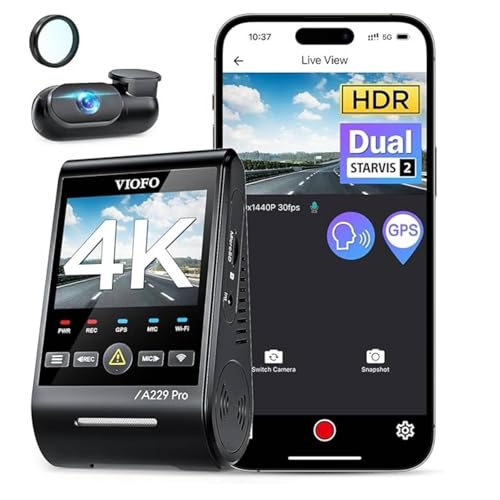
Viofo's current A229-series and A119 Mini-series publish front resolutions up to 4K (3840×2160) with Sony STARVIS 2 sensors on flagship models. Published bitrates for 4K models run 20–40 Mbps on higher-quality settings. Field-of-view figures on Viofo front channels are typically 140°–160°. Viofo publishes HDR / WDR processing as standard on recent models.
Viofo's A229 Pro publishes dual-channel front-and-rear recording (4K front + 1440p rear), buffered parking mode, GPS, and a CPL filter socket on the front lens — a feature that reduces windshield reflection in night footage, which most aggregated expert reviews flag as meaningful for plate legibility. Viofo cameras are sold primarily through Amazon. → View Viofo 4K dash cams on Amazon
Side-by-Side Spec Comparison
| Feature | Garmin (flagship models) | Viofo A229-series |
|---|---|---|
| Published max front resolution | 1440p–4K (model-dependent) | 4K (3840×2160) |
| Published sensor | Varies by model | Sony STARVIS 2 (flagship) |
| Published bitrate | ~20–30 Mbps | 20–40 Mbps |
| HDR / WDR | Yes (select models) | Yes |
| CPL filter socket | No | Yes (A229 Pro) |
| Field of view (front) | ~140°–150° | ~140°–160° |
| GPS | Yes | Yes |
| Voice control | Yes | No |
| Cloud storage option | Garmin Vault (subscription) | No |
| Available via | Garmin.com (CJ affiliate) | Amazon |
| Commission rate | 8% | ~2% (Amazon) |
Night Legibility Analysis: What the Specs Suggest
Sensor Advantage
Viofo publishes the Sony STARVIS 2 sensor on its current A229-series models. Sony STARVIS 2 is a back-illuminated (BSI) CMOS design that Sony rates for improved low-light sensitivity. Garmin does not universally publish sensor model information across its line; where aggregated reviews have confirmed sensor details they tend to be competitive but vary by Garmin SKU. On published specs alone, Viofo's flagship sensor claim is more specific and verifiable.
Bitrate Advantage
Higher bitrate reduces compression artifacts in high-noise scenes (nighttime). Viofo's published maximum of 40 Mbps on 4K mode is higher than the published Garmin figures typically cited in aggregated expert reviews. A plate character in a noisy night scene is more likely to survive the compression at 40 Mbps than at 20 Mbps.
CPL Filter: The Practical Edge
A CPL (circular polarizing lens) filter reduces glare from the windshield glass itself — a significant source of ghosting in night recordings where cabin lights or bright instrument panels reflect onto the glass in front of the camera. Viofo publishes a CPL filter socket as a feature on the A229 Pro; Garmin compact models do not include this socket. Aggregated expert reviews consistently flag the CPL option as the most practical tool for night reflection reduction.
Form Factor Tradeoff
Garmin's compact, mirror-mounted designs are highly rated for driver visibility — the camera does not obstruct the sightline. Viofo's A229 series is physically larger. Neither is rated by experts as a visibility hazard, but some owner reviews note Viofo's size on smaller windshields.
Verdict
For maximum published night legibility specs: Viofo's A229 Pro publishes a stronger combination of sensor type (Sony STARVIS 2), bitrate (up to 40 Mbps), and CPL filter socket. Based on aggregated expert analysis, these three factors together offer the best documented ingredients for readable night plates. → View Viofo 4K dash cams on Amazon
For ecosystem integration, compact form factor, and cloud features: Garmin's lineup excels. Voice control, Vault cloud storage, and near-invisible mounting are published advantages that aggregated reviews consistently validate. Drivers who value seamless operation over raw low-light spec on paper should lean Garmin. → View Garmin dash cam lineup
The honest caveat: Manufacturer-published sensor and bitrate figures are the best available proxy for night performance, but real license-plate legibility at 30–50 feet at night also depends on the driver's specific bitrate setting, card write speed, temperature, and whether HDR mode is enabled. No published figure guarantees a readable plate in every real-world night scenario.
All specifications cited are manufacturer-published figures and aggregated expert and owner review data as of 2026. Actual night recording quality depends on multiple factors beyond the rated specs.
Affiliate Disclosure